


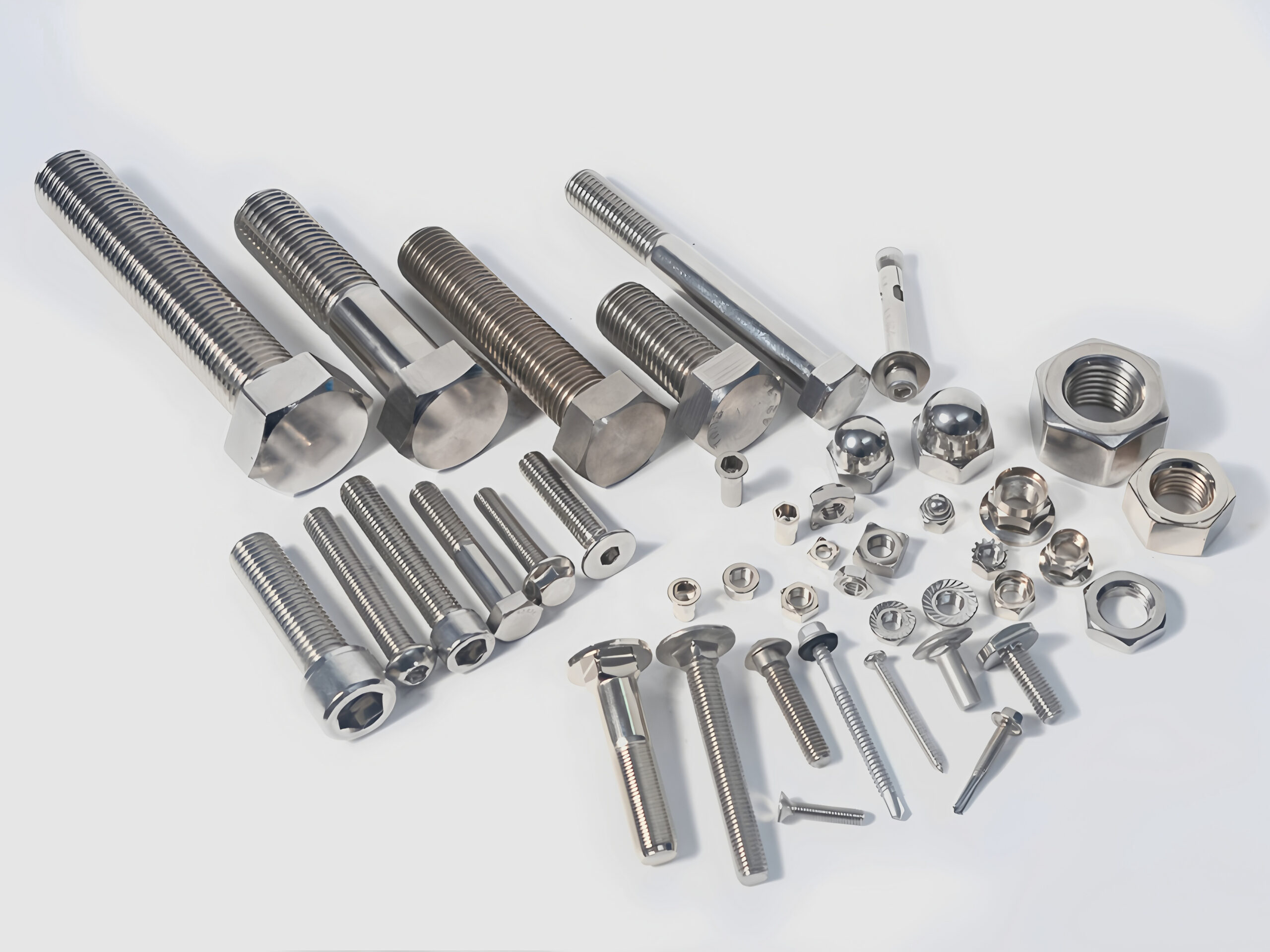
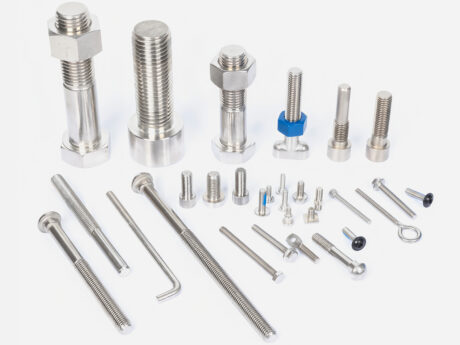
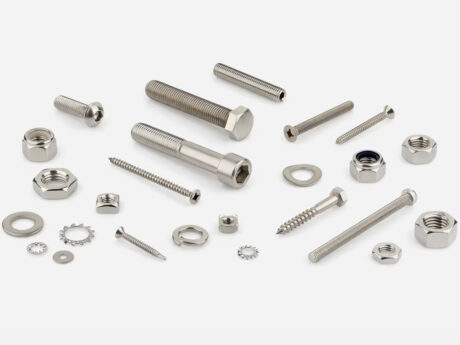
Zirconium fasteners are corrosion‑resistant threaded components manufactured from commercial zirconium (and selected zirconium alloys) and supplied as:
-
Bolts / Screws: hex bolts, heavy hex bolts, hex cap screws, socket head cap screws, machine screws, countersunk screws
-
Studs: fully threaded studs, tap-end studs, double-end studs, custom studs
-
Nuts: hex nuts, heavy hex nuts, jam nuts, coupling nuts
-
Washers / Spacers / Shims: flat washers, custom washers, precision shims (laser cut / stamped)
-
Custom parts: special fasteners per drawing (non-standard head forms, special threads, flanges, etc.)
Zirconium fasteners are primarily selected for maximum corrosion resistance in aggressive chemical environments and for applications where zirconium’s nuclear compatibility / low neutron absorption is required in nuclear systems.
2) Typical applications
-
Chemical process equipment: reactors, columns, piping systems, pumps, heat exchangers, agitators, valves, and flanged joints exposed to highly corrosive media
-
Nuclear service: components and internal structures where zirconium alloys are commonly used due to nuclear performance requirements
-
Pharmaceutical / specialty chemicals: where high purity and corrosion resistance are required
-
Marine / chloride environments: where corrosion performance outweighs strength requirements (application-dependent)
Important compatibility note (engineering): zirconium’s corrosion resistance can be severely reduced in the presence of fluoride / hydrofluoric acid (HF); fluoride contamination in process acids can rapidly attack zirconium under certain conditions.
3) Material grades (UNS / ASTM grades)
Zirconium fasteners are most commonly produced from ASTM B550/B550M bar (machined fasteners) or from ASTM B493/B493M forgings (forged blanks for bolts/studs), with washer/shim stock commonly sourced from ASTM B551/B551M strip/sheet/plate.
Standard commercial grades for fasteners (ASTM B550/B550M)
ASTM B550/B550M defines zirconium bar and wire grades commonly used as fastener raw material: R60702, R60704, R60705.
-
UNS R60702 (Zr 702 / commercially pure zirconium)
Best overall corrosion resistance + ductility; preferred for many chemical applications. -
UNS R60704 (Zr 704 / Zr‑Sn alloy)
Higher strength than 702; good corrosion resistance. -
UNS R60705 (Zr 705 / Zr‑Nb alloy)
Higher strength than 702; widely used for stronger zirconium fasteners while retaining excellent corrosion performance.
4) Chemical composition requirements (summary)
The following is a technical summary of the chemical requirements for the three B550 grades (limits in weight %).
| Element (wt. %) | R60702 (Zr 702) | R60704 (Zr 704) | R60705 (Zr 705) |
|---|---|---|---|
| Zirconium + Hafnium, min | 99.2 | 97.5 | 95.5 |
| Hafnium, max | 4.5 | 4.5 | 4.5 |
| Iron + Chromium | 0.20 max | 0.20–0.40 | 0.20 max |
| Tin (Sn) | — | 1.0–2.0 | — |
| Niobium (Nb) | — | — | 2.0–3.0 |
| Hydrogen, max | 0.005 | 0.005 | 0.005 |
| Nitrogen, max | 0.025 | 0.025 | 0.025 |
| Carbon, max | 0.05 | 0.05 | 0.05 |
| Oxygen, max | 0.16 | 0.18 | 0.18 |
Chemical test basis (traceability): B550 states that the manufacturer’s ingot analysis is considered the chemical analysis except hydrogen and nitrogen, which are determined on the finished product.
5) Mechanical property grades (strength “levels”)
Zirconium fasteners are typically ordered by material grade (R60702 / R60704 / R60705) rather than steel-style property classes (8.8 / 10.9) because zirconium is selected mainly for corrosion performance.
A practical approach for procurement is:
-
Specify UNS/ASTM grade (e.g., R60705)
-
Specify condition (commonly annealed, unless otherwise required)
-
Specify mechanical test requirements (tensile, proof load for nuts if applicable, etc.)
-
Specify thread class + dimensional standard
Tensile requirements (B550 annealed bar — summary)
ASTM B550 requires minimum tensile properties at room temperature for annealed bar (note: the table is for bar; finished fastener properties depend on manufacturing route).
| Grade | Tensile Strength, min | Yield Strength (0.2% offset), min | Elongation, min |
|---|---|---|---|
| R60702 | 55 ksi (380 MPa) | 30 ksi (205 MPa) | 16% |
| R60704 | 60 ksi (415 MPa) | 35 ksi (240 MPa) | 14% |
| R60705 | 80 ksi (550 MPa) | 55 ksi (380 MPa) | 16% |
6) Applicable standards (recommended “complete set”)
6.1 Material standards (zirconium)
Use these to define the raw material for machining/forging/stamping:
-
ASTM B550/B550M — Zirconium and zirconium alloy bar and wire (R60702 / R60704 / R60705); includes chemistry, tensile requirements, and dimensional tolerances for bar/wire.
-
ASTM B493/B493M — Zirconium and zirconium alloy forgings; forgings are furnished annealed; includes chemistry + tensile requirements and inspection provisions.
-
ASTM B551/B551M — Zirconium and zirconium alloy strip/sheet/plate (commonly used for washers, shims, and stamped components).
-
ASTM B351/B351M — Zirconium and zirconium alloy bars/rods/wire for nuclear application (specific nuclear UNS grades).
ASME BPVC note: ASTM B493 explicitly references a corresponding ASME Section II specification (SB‑493) for Boiler & Pressure Vessel Code applications.
(ASTM B550 similarly references SB‑550 for ASME BPVC usage.)
6.2 Dimensional / product form standards (choose per part type)
These standards define head dimensions, across flats, washer OD/ID, etc. (material is still zirconium per ASTM/ASME above):
ASME/ANSI (inch-series):
-
ASME B18.2.1 (hex bolts / hex cap screws)
-
ASME B18.2.2 (hex nuts)
-
ASME B18.3 (socket head cap screws)
-
ASME B18.21.1 (washers)
-
ASME B18.31.2 (continuous-thread studs / stud bolts)
ISO (metric-series):
-
ISO 4014 / 4017 (hex bolts / screws)
-
ISO 4032 (hex nuts)
-
ISO 4762 (socket head cap screws)
-
ISO 7089 / 7090 (flat washers)
6.3 Thread standards (choose metric or unified)
-
Unified threads: ASME B1.1 (UNC/UNF/UNEF)
-
Metric threads: ISO 261 (basic series) + ISO 965 (tolerances)
Typical thread tolerance classes used in procurement:
-
Metric: 6g (external) / 6H (internal) unless otherwise specified
-
Unified: 2A (external) / 2B (internal); 3A/3B for precision fits
6.4 Inspection and test standards (typical for critical fasteners)
-
Tensile testing of zirconium material forms is commonly performed per ASTM E8 (referenced within zirconium material standards such as B550 and B493).
-
Additional controls often specified by purchaser: dimensional inspection, surface quality, PMI, lot traceability, and cleanliness requirements (especially for nuclear/chemical service).
7) Specification and dimensional capabilities (fastener supply range)
Because zirconium is typically produced via machining/forging rather than mass cold-heading, the most common supply ranges are:
7.1 Diameter / thread size ranges (typical industry supply)
-
Metric: M3 to M64 (larger sizes on request)
-
Inch: 1/4″ to 2″ (larger on request)
7.2 Length ranges
-
Typical bolt/screw length: 6 mm to 300 mm
-
Studs: commonly up to 1000 mm depending on diameter and straightness requirements
7.3 Thread forms
-
Coarse and fine pitch per ISO/ASME thread standards
-
Thread production: single‑point cut, die cut, or rolled (rolling depends on size and grade and is agreed during manufacture)
7.4 Standard part geometry
Unless the order specifies otherwise, zirconium fasteners are manufactured to:
-
One of the standards listed in 6.2, or
-
Customer drawings (recommended for non-standard head styles, undercut shanks, special chamfers/radii, or special thread runouts)
8) Manufacturing, condition, and surface finish
8.1 Manufacturing routes
-
Machined fasteners from zirconium bar/rod (ASTM B550/B550M) are the most common for high-integrity service.
-
Forged blanks (ASTM B493/B493M) may be used for heavy sections, improved grain flow, or certain bolt heads/studs.
-
Washers/shims are commonly stamped/laser cut from zirconium sheet/plate (ASTM B551/B551M).
8.2 Condition (heat treatment)
-
Zirconium material for fastener manufacture is frequently supplied annealed per the relevant zirconium standard requirements.
8.3 Typical surface finishes (orderable)
-
As-machined (cleaned and degreased)
-
Pickled / descaled (when required by material standard or purchaser’s spec)
-
Fine-turned / polished for cleanliness or crevice corrosion control (application-dependent)
For critical chemical/nuclear service, it is common to specify cleanliness controls (no halogens/fluorides, controlled lubricants, sealed packaging).
9) Quality, inspection, certification, and traceability (professional procurement package)
A “most professional” zirconium fastener supply package typically includes:
-
Material Test Report (MTR) showing:
-
Grade/UNS and governing material spec (e.g., ASTM B550 R60705)
-
Heat/lot traceability
-
Chemistry results (including H and N where required on finished product per material standard)
-
Mechanical test results (tensile, elongation as specified)
-
-
Dimensional inspection report (critical dimensions, thread gaging results)
-
Positive Material Identification (PMI) when requested (especially for mixed-alloy sites)
-
Certificate type commonly requested in international trade: EN 10204 3.1 (by agreement)
-
Optional: NDT (PT/UT) for specific critical parts, if agreed and technically applicable
10) Marking and packaging (typical best practice)
-
Marking: low-stress marking (laser marking / dot peen) preferred for corrosion-critical service; include at minimum grade + heat/lot when practical.
-
Packaging: individually bagged or partitioned packaging to avoid surface damage; moisture control; clean labeling with full traceability.
11) How to write a complete ordering specification (template)
To avoid ambiguity, specify all of the following in the PO:
-
Fastener type (hex bolt / stud / nut / washer / custom drawing)
-
Quantity
-
Size (diameter × pitch × length)
-
Thread standard + tolerance class (ISO/ASME; 6g/6H or 2A/2B, etc.)
-
Dimensional standard (ASME B18 / ISO number) or drawing number/revision
-
Material grade & standard (e.g., ASTM B550 Grade R60705)
-
Condition (annealed unless otherwise specified)
-
Surface finish / cleanliness requirement
-
Inspection / documentation package (MTR, PMI, dimensional report, etc.)
-
Special requirements (service media, max fluoride, nuclear requirements, etc.)
Example (professional line item):
“Stud bolts, M20 × 2.5 × 200 mm, ISO thread tolerance 6g, per drawing ABC‑123 Rev.B; material ASTM B550/B550M Grade R60705 (UNS R60705), annealed; supply with MTR showing chemistry and tensile results; cleaned for chemical service and packaged to prevent contamination.”