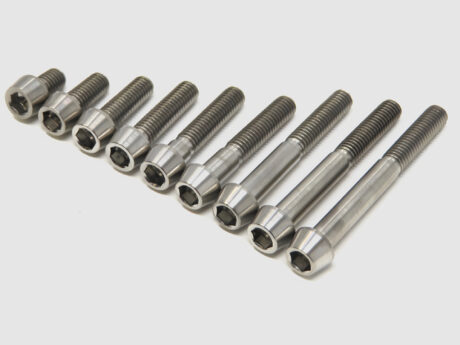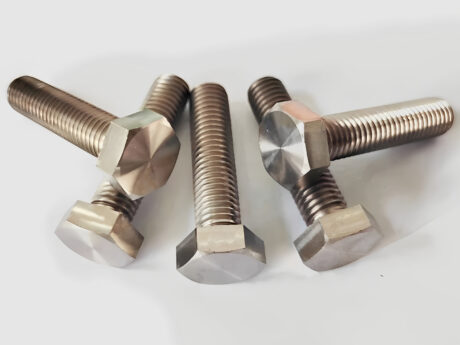
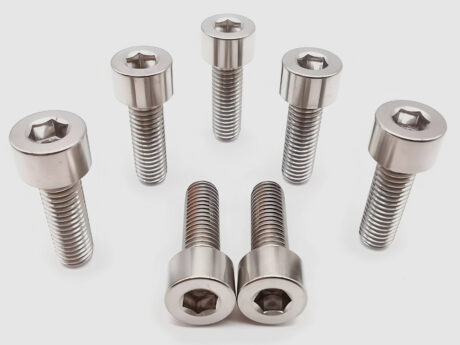
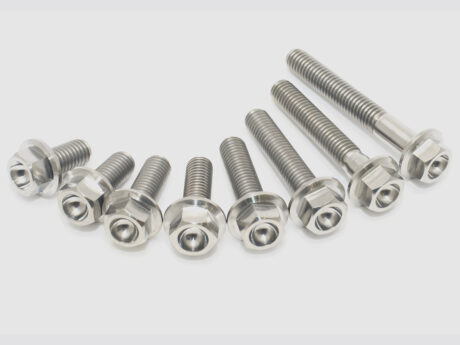
Titanium stud bolts are manufactured from commercially pure (CP) titanium or titanium alloys. The grade defines the chemical composition, which directly influences mechanical properties and corrosion resistance .
Table: Chemical Composition of Key Titanium Grades for Stud Bolts (Weight % Maximum, unless range is specified)
|
Grade
|
UNS Code
|
Fe (max)
|
O (max)
|
C (max)
|
N (max)
|
H (max)
|
Other Elements
|
Ti
|
|---|---|---|---|---|---|---|---|---|
|
Grade 1
|
R50250
|
0.20
|
0.18
|
0.10
|
0.03
|
0.015
|
–
|
Balance
|
|
Grade 2
|
R50400
|
0.30
|
0.25
|
0.10
|
0.03
|
0.015
|
–
|
Balance
|
|
Grade 5
|
R56400
|
0.40
|
0.20
|
0.10
|
0.05
|
0.0125
|
Al: 5.5-6.75, V: 3.5-4.5
|
Balance
|
|
Grade 7
|
R52400
|
0.30
|
0.25
|
0.10
|
0.03
|
0.0125
|
Pd: 0.12-0.25
|
Balance
|
|
Grade 9
|
R56320
|
Information not fully specified in search results (Ti-3Al-2.5V alloy)
|
Balance
|
|||||
|
Grade 12
|
R53400
|
Information not fully specified in search results (Ti-0.3Mo-0.8Ni alloy)
|
Balance
|
|||||
|
Grade 23
|
R56401
|
0.25
|
0.13
|
0.08
|
0.05
|
0.0125
|
Al: 5.5-6.5, V: 3.5-4.5
|
Balance
|
2. Standards and Specifications
Titanium stud bolts are produced according to international standards governing dimensions, tolerances, testing, and material quality .
-
Material Standards: The primary standards for the material quality of titanium fasteners are ASTM F467 / F467M for nuts and ASTM F468 / F468M for bolts, screws, and studs. These standards cover grades including 1, 2, 4, 5, 7, 19, 23, and 32 .
-
Dimensional Standards: While stud bolts can be manufactured to various dimensional standards (such as ASME B18.2.1), the thread profiles and general dimensions are typically controlled by standards like ASTM B1.13M for metric threads .
-
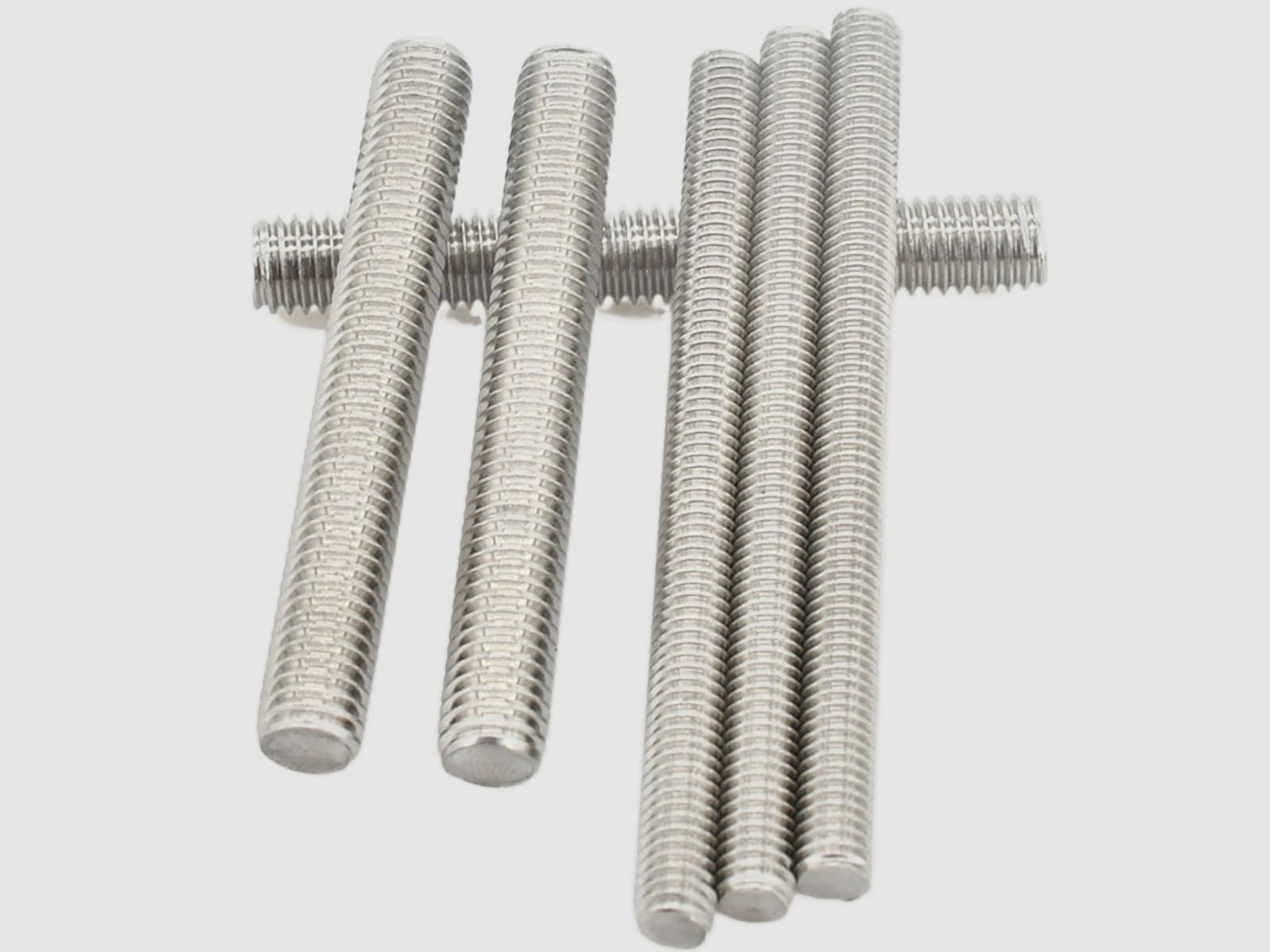
Threaded Rod Standards (DIN 975 / DIN 976): These are specific standards for fully threaded rods (allthreads) .
-
DIN 975: Typically refers to longer, continuous lengths of threaded rod (often supplied in coils or long straight lengths).
-
DIN 976: More commonly associated with shorter, cut-to-length pieces of threaded studding .
-
These standards cover a wide range of metric sizes, commonly from M2 to M52, and can be manufactured in titanium and its alloys .
-
3. Mechanical Properties
The mechanical properties vary significantly by grade, which dictates their suitability for different applications .
Table: Mechanical Properties of Titanium Stud Bolts (Minimum Values)
|
Grade
|
Common Designation
|
Tensile Strength (min)
|
Yield Strength (min)
|
Elongation (min %)
|
Key Characteristics
|
|---|---|---|---|---|---|
|
MPa
|
ksi
|
MPa
|
ksi
|
||
|
Grade 1
|
CP / TA1
|
240
|
35
|
170
|
25
|
|
Grade 2
|
CP / TA2
|
345
|
50
|
275
|
40
|
|
Grade 5
|
Ti-6Al-4V / TC4
|
895
|
130
|
828
|
120
|
|
Grade 7
|
Ti-0.2Pd / TA10
|
345
|
50
|
275
|
40
|
|
Grade 9
|
Ti-3Al-2.5V
|
~620*
|
~90*
|
~483*
|
~70*
|
|
Grade 12
|
Ti-0.3Mo-0.8Ni
|
~483*
|
~70*
|
~345*
|
~50*
|
|
Grade 23
|
Ti-6Al-4V ELI
|
828
|
120
|
759
|
110
|
Note: Mechanical properties for Grade 9 and Grade 12 are typical values from general material specifications .
4. Specifications, Sizes, and Dimensions
-
Sizes: Standard metric thread sizes for titanium stud bolts and threaded rods typically range from M1.6 (or smaller) to M64 . Custom sizes outside this range are also available.
-
Lengths: Standard lengths can vary, but are commonly available from about 6mm to 300mm for finished studs . Threaded rods (DIN 975/976) can be supplied in long lengths (e.g., 1000mm, 3000mm) and cut to requirement .
-
Configuration: Stud bolts can be continuous threaded (like DIN 975/976 rods) or have a threaded portion on each end with an unthreaded shank in the center.
5. Key Characteristics and Advantages
-
High Strength-to-Weight Ratio: Titanium bolts are about 40-45% lighter than steel bolts of equivalent strength, leading to significant weight savings in applications like aerospace and automotive .
-
Exceptional Corrosion Resistance: They exhibit outstanding resistance to seawater, chlorides, oxidizing environments, and a wide range of chemicals due to a stable, protective oxide layer that reforms instantly in the presence of oxygen .
-
Temperature Resistance: Titanium retains mechanical properties over a wide temperature range, from cryogenic to elevated temperatures (depending on the grade) .
-
Biocompatibility: Grades 1, 2, 5, and 23 are biocompatible, making them suitable for medical implants and surgical instruments .
-
Non-Magnetic Properties: Ideal for applications in electronics, MRI machines, and other areas where magnetic interference must be avoided .
6. Applications by Grade
|
Grade
|
Typical Applications
|
|---|---|
|
Grade 1/2
|
Chemical processing equipment, marine hardware, architectural façades, desalination plants, where maximum corrosion resistance and formability are needed .
|
|
Grade 5
|
Aerospace structures (airframes, engine components), high-performance automotive, marine engineering, surgical tools .
|
|
Grade 7
|
Chemical reactors, piping systems for aggressive reducing acids (e.g., sulfuric acid, hydrochloric acid) .
|
|
Grade 9
|
Aircraft hydraulic systems, sporting equipment, applications requiring strength between CP titanium and Grade 5 .
|
|
Grade 12
|
Heat exchangers, shell and tube heat exchangers, chemical processing equipment exposed to crevice corrosion .
|
|
Grade 23
|
Medical implants (joint replacements, bone plates), critical aerospace assemblies requiring high fracture toughness .
|