Titanium Set Screw, also commonly known as a grub screw, is a type of fastener that is fully threaded and typically headless. Its primary function is to secure one object within or against another object, such as fixing a gear, pulley, or collar to a shaft, preventing relative movement. Unlike standard screws, set screws are designed to be fully embedded within a threaded hole, resulting in a flush mounting surface which is critical in assemblies with space constraints or rotating components .
The exceptional performance of titanium set screws stems from the intrinsic properties of titanium and its alloys. Titanium possesses a unique combination of a high strength-to-weight ratio, exceptional corrosion resistance, and excellent fatigue resistance. With a density of approximately 4.51 g/cm³, titanium is about 45% lighter than steel while offering comparable, and in some alloys superior, strength. This makes it ideal for weight-critical applications in aerospace, high-performance automotive, and medical industries .
2. Material Grades, Compositions, and Mechanical Properties
Titanium set screws are available in various grades, each tailored for specific performance requirements. The selection of the appropriate grade is crucial for ensuring reliability and longevity in the intended application .
The table below provides a detailed comparison of the common and requested titanium grades. Note: Information on Grade 1, Grade 9, and Grade 12 was not extensively available in the search results, and their use in set screws may be less common. The following table focuses on grades with detailed, available data .
|
Grade
|
Common Alloy Name / UNS Number
|
Key Characteristics and Typical Applications
|
Key Specifications
|
|---|---|---|---|
|
Grade 2
|
Commercially Pure Titanium / UNS R50400
|
The most common grade for general-purpose applications. Offers an excellent balance of formability, weldability, and corrosion resistance. Ideal for marine environments and chemical processing equipment where high mechanical strength is not the primary requirement .
|
ASTM B348, ASTM F67, AMS 4921
|
|
Grade 5
|
Ti-6Al-4V / UNS R56400
|
The “workhorse” titanium alloy. It is significantly stronger than Grade 2 (approximately twice the strength) while maintaining good corrosion resistance. Its excellent strength-to-weight ratio makes it the premier choice for aerospace, automotive racing, and high-performance engineering .
|
ASTM B348, ASTM F467, AMS 4911
|
|
Grade 7
|
Ti-0.15Pd / UNS R52400
|
Similar to Grade 2 but with the addition of 0.12-0.25% Palladium. This alloy provides enhanced resistance to reducing acids and localized corrosion in hot halide environments, making it supremely suited for chemical processing plants .
|
ASTM B348, ASTM B338
|
|
Grade 23
|
Ti-6Al-4V ELI (Extra Low Interstitial) / UNS R56401
|
A higher purity version of Grade 5 with lower levels of oxygen, iron, and other interstitial elements. This grants it enhanced fracture toughness, superior ductility, and improved fatigue crack propagation resistance. It is the preferred material for medical implants and critical aerospace applications .
|
ASTM F136, AMS 4907
|
Typical Mechanical Properties for Key Grades :
-
Grade 2 (CP Titanium): Tensile Strength: ~ 345 MPa (Min), Yield Strength: ~ 275 MPa (Min).
-
Grade 5 (Ti-6Al-4V): Tensile Strength: 950 – 1180 MPa, Yield Strength: 880 – 1100 MPa, Elongation: 10% – 15%. This grade offers a minimum yield strength of approximately 128,000 psi (880 MPa) .
3. Standards, Specifications, Sizes, and Points
Titanium set screws are manufactured to conform to international standards that govern their dimensions, tolerances, and mechanical properties .
-
Common Dimensional Standards:
-
ISO 4026 / DIN 913: Metric socket set screws, flat point.
-
ISO 4027 / DIN 914: Metric socket set screws, cone point.
-
ISO 4028 / DIN 915: Metric socket set screws, dog point.
-
ISO 4029 / DIN 916: Metric socket set screws, cup point.
-
ASME B18.3: Covers set screws in inch sizes.
-
-
Material and Testing Standards: The titanium raw material is often certified to ASTM B348 for bars and billets, while the finished fasteners may be supplied to standards like ASTM F467 for non-ferrous fasteners .
Standard metric thread sizes are readily available from as small as M1.6 up to M64, and imperial sizes from #0-80 to 2 inches in diameter. Lengths typically range from 3 mm to 200 mm .
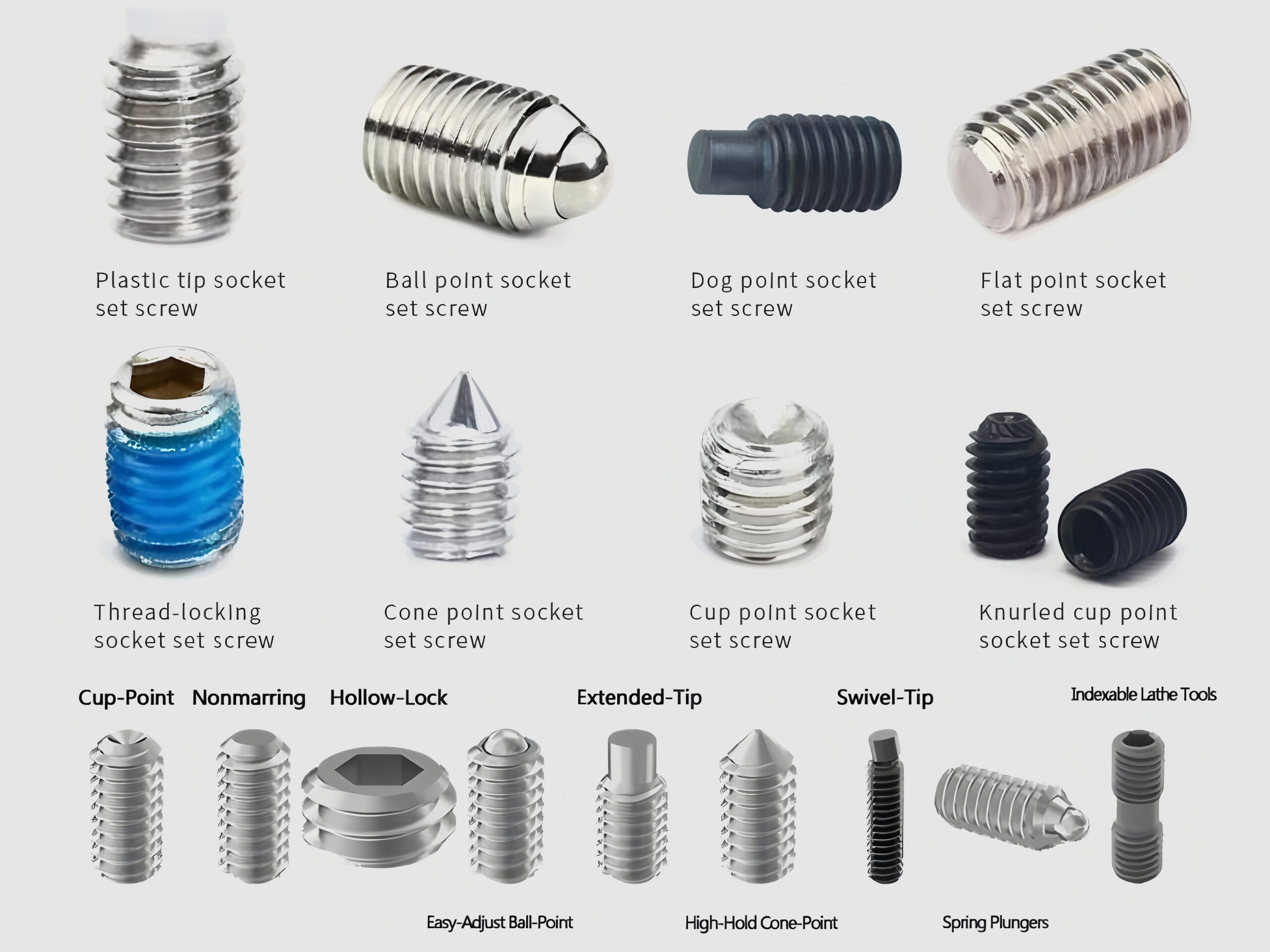
The functionality of a set screw is largely determined by its point type, which defines how it engages the shaft :
-
Cup Point: The most common type. A cupped indentation creates a sharp edge that bites into the shaft, providing strong resistance to rotation. Best for semi-permanent or permanent applications .
-
Cone Point: A sharp, conical point that provides the strongest clamping force due to deep penetration. Used for permanent assemblies but causes significant shaft deformation .
-
Flat Point: Has a flat surface that minimizes damage to the shaft. Ideal for applications requiring frequent adjustments or where the set screw must bear against a hardened shaft .
-
Half-Dog / Full-Dog Point: A cylindrical pilot point that engages a pre-drilled hole in the shaft, providing the most positive locking action and preventing axial movement. Used in high-torque applications .
-
Knurled Cup Point: Similar to a cup point but with added knurling, which can provide better grip on smooth shafts .
4. Advantages and Limitations
Advantages:
-
High Strength-to-Weight Ratio: Titanium provides strength comparable to steel at about 45% of the weight, which is crucial for weight-saving in aerospace and performance vehicles .
-
Exceptional Corrosion Resistance: Titanium naturally forms a stable, protective oxide layer that renders it highly resistant to corrosion, including in seawater, chlorides, and chlorine compounds. It can withstand seawater temperatures up to 260°C (500°F) .
-
Excellent Fatigue Resistance: They can endure repeated loading and unloading cycles without failure, making them suitable for dynamic or high-stress environments like engines and flight control systems .
-
Biocompatibility and Non-Magnetic Properties: Grades like 23 are biocompatible, making them suitable for medical implants. The non-magnetic nature is essential for MRI machines and sensitive electronics .
Limitations:
-
Cost: Titanium and its machining process are more expensive than steel or aluminum, making these fasteners a premium choice .
-
Galling Tendency: Titanium has a tendency to gall or seize during installation, especially if proper techniques are not used. This necessitates the use of specialized lubricants or anti-galling coatings during threading .
-
Specialized Installation Requirements: Proper installation often requires specific tools and expertise to achieve the correct torque and prevent damage to the screw or the workpiece .
5. Application Industries
Titanium set screws are specified in demanding industries where their unique properties provide critical advantages :
-
Aerospace & Aviation: For securing critical components in aircraft structures, engine mounts, and avionics, where weight reduction and reliability are paramount.
-
Marine & Offshore: In boat fittings, subsea instruments, and desalination plants due to their unparalleled resistance to seawater corrosion.
-
Chemical Processing: In pumps, valves, and reactors handling corrosive acids and chlorides, with Grade 7 being particularly resistant.
-
Medical Devices: In surgical instruments and non-implantable equipment, with Grade 23 used for implantable devices due to its biocompatibility.
-
High-Performance Automotive & Motorsports: In engines, gearboxes, and suspension systems to reduce weight and withstand high vibrations and temperatures.
6. The following table provides a clear overview of the most common set screw point types, which is the primary way they are classified.
|
Point Type
|
Key Characteristics
|
Best For
|
Surface Damage
|
Reusability/Adjustability
|
Common Standards
|
|---|---|---|---|---|---|
|
Cup Point
|
Concave, cupped indentation creating a sharp edge.
|
High grip applications; most common type; strong hold on shafts.
|
High – the rim cuts into the surface.
|
Semi-permanent; adjustable but may lose holding power.
|
DIN 916, ISO 4029
|
|
Cone Point
|
Sharp, pointed conical end.
|
Permanent settings; deep penetration for excellent grip, especially in softer materials.
|
Very High – deep penetration.
|
Least adjustable; considered permanent.
|
DIN 914, ISO 4027
|
|
Flat Point
|
Flat, square end.
|
Frequent adjustments; applications requiring minimal surface damage or on flat, hardened shafts.
|
Very Low – presses flush against the surface.
|
High – designed for repeated adjustment.
|
DIN 913, ISO 4026
|
|
Half-Dog / Dog Point
|
Cylindrical protruding tip.
|
Precise location into a pre-drilled hole or groove; prevents axial movement.
|
Low (if hole is pre-drilled) – locates without digging.
|
Good for assembly/disassembly if hole is used.
|
DIN 915, ISO 4028
|
|
Oval Point
|
Rounded, oval-shaped end.
|
Frequent adjustments on sloped or grooved surfaces; a compromise between cup and flat points.
|
Low to Moderate.
|
High – similar to flat point.
|
(Less common, may be variant-specific)
|
|
Knurled Cup Point
|
Cup point with a textured (knurled) surface.
|
High-vibration environments like motors and machinery; enhanced resistance to loosening.
|
High – digs in and grips aggressively.
|
Semi-permanent; not for frequent adjustment.
|
(A specialized variant)
|
🔩 Other Classification Criteria
Beyond the point type, set screws can also be categorized by other features:
-
Drive Type: This refers to the recess in the headless body used for driving the screw.
-
Hexagon Socket / Allen Drive: The most common type, requiring a hex key .
-
Slotted Drive: Less common, requires a flat-head screwdriver .
-
Square Head: Allows for high torque with a wrench, but the head cannot be countersunk .
-
-
Head Style: While often called “headless,” this refers to the top configuration.
-
Headless (Grub Screw): Sits entirely within a hole for a flush finish .
-
Square Head: As mentioned, has a protruding square head for high torque application .
-
📝 How to Choose the Right Set Screw
Selecting the appropriate set screw depends on your specific application requirements :
-
Required Grip Strength: For the strongest, most permanent hold, a Cup or Cone Point is best.
-
Need to Avoid Surface Damage: If the shaft or mating surface must not be marred, use a Flat or Dog Point (with a pre-drilled hole).
-
Frequency of Adjustment: For parts that need regular adjustment or removal, choose a Flat or Oval Point.
-
Environmental Conditions: In high-vibration environments, a Knurled Cup Point is superior at resisting loosening.
-
Shaft Material: Cone points work well on softer materials, while flat points are better for hardened shafts.