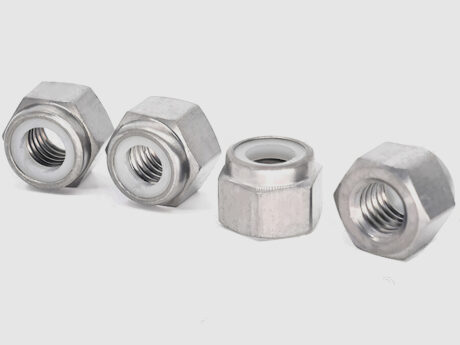
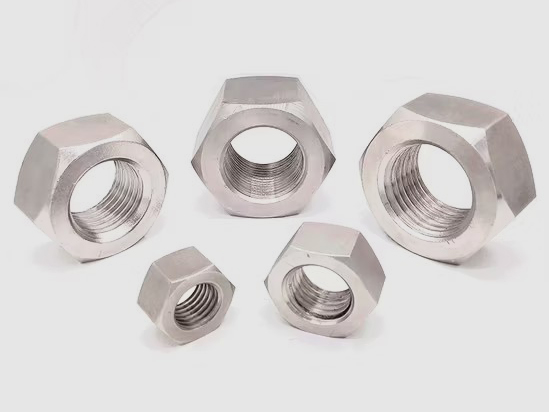
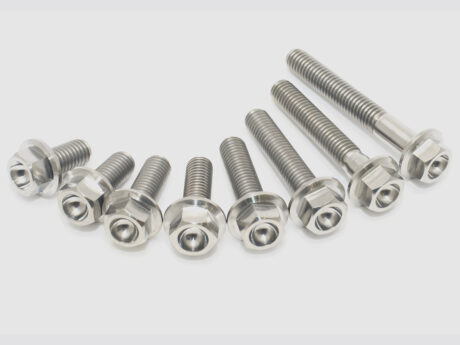
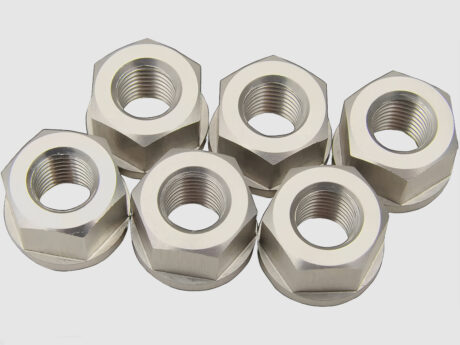
Titanium Hex Nuts
1. Material Grades and Mechanical Properties
Titanium hex nuts are manufactured from commercially pure (CP) titanium or titanium alloys, with the grade determining key properties such as strength, corrosion resistance, and suitability for specific environments.
Table: Chemical Composition of Key Titanium Grades for Nuts (Weight % Maximum, unless range is specified)
|
Grade
|
UNS Code
|
Fe (max)
|
O (max)
|
C (max)
|
N (max)
|
H (max)
|
Other Elements
|
Ti
|
|---|---|---|---|---|---|---|---|---|
|
Grade 1
|
R50250
|
0.20
|
0.18
|
0.10
|
0.03
|
0.015
|
–
|
Balance
|
|
Grade 2
|
R50400
|
0.30
|
0.25
|
0.10
|
0.03
|
0.015
|
–
|
Balance
|
|
Grade 5
|
R56400
|
0.40
|
0.20
|
0.10
|
0.05
|
0.0125
|
Al: 5.5-6.75, V: 3.5-4.5
|
Balance
|
|
Grade 7
|
R52400
|
0.30
|
0.25
|
0.10
|
0.03
|
0.0125
|
Pd: 0.12-0.25
|
Balance
|
|
Grade 9
|
R56320
|
Information not fully specified in search results (Ti-3Al-2.5V alloy)
|
Balance
|
|||||
|
Grade 12
|
R53400
|
Information not fully specified in search results (Ti-0.3Mo-0.8Ni alloy)
|
Balance
|
|||||
|
Grade 23
|
R56401
|
0.25
|
0.13
|
0.08
|
0.05
|
0.0125
|
Al: 5.5-6.5, V: 3.5-4.5
|
Balance
|
Table: Mechanical Properties of Titanium Hex Nuts (Minimum Values, per ASTM Standards)
|
Grade
|
Common Designation
|
Tensile Strength (min)
|
Yield Strength / Proof Load (min)
|
Elongation (min %)
|
Hardness (min)
|
Key Characteristics
|
|---|---|---|---|---|---|---|
|
MPa
|
ksi
|
MPa
|
ksi
|
|||
|
Grade 1
|
CP / TA1
|
240
|
35
|
170 (Proof)
|
25 (Proof)
|
24
|
|
Grade 2
|
CP / TA2
|
345
|
50
|
275 (Proof)
|
40 (Proof)
|
20
|
|
Grade 5
|
Ti-6Al-4V / TC4
|
895
|
130
|
828 (Yield)
|
120 (Yield)
|
10
|
|
Grade 7
|
Ti-0.2Pd / TA10
|
345
|
50
|
275 (Proof)
|
40 (Proof)
|
20
|
|
Grade 9
|
Ti-3Al-2.5V
|
~620*
|
~90*
|
~483* (Yield)
|
~70* (Yield)
|
~15*
|
|
Grade 12
|
Ti-0.3Mo-0.8Ni
|
~483*
|
~70*
|
~345* (Proof)
|
~50* (Proof)
|
~18*
|
|
Grade 23
|
Ti-6Al-4V ELI
|
828
|
120
|
759 (Yield)
|
110 (Yield)
|
10
|
Note: Mechanical properties for Grade 9 and Grade 12 are typical values from general material specifications and may vary for nut-specific standards.
2. Standards and Specifications
Titanium hex nuts are produced in accordance with international standards that govern dimensions, mechanical properties, and testing.
-
Dimensional Standards: Common standards include DIN 934 (standard hex nuts), DIN 439 (thin hex nuts), ISO 4032, and ASME/ANSI B18.2.2.
-
Material & Quality Standards: Key standards are ASTM F467 / F467M (specifically for titanium and titanium alloy nuts) and ASTM B348 for bar stock. Quality certification such as EN 10204 3.1 is commonly available.
3. Specifications, Sizes, and Dimensions
Standard sizes range from M1.6 to M64 and even larger for custom orders. The dimensions (width across flats, thickness, thread pitch) are defined by the relevant standard.
Table: Example Dimensions for Metric Titanium Hex Nuts (Based on DIN 934 Standard)
|
Thread Size (d)
|
Pitch (P) [mm]
|
Thickness (k) [mm]
|
Width Across Flats (s) [mm]
|
|---|---|---|---|
|
Max
|
Min
|
||
|
M4
|
0.7
|
3.2
|
2.9
|
|
M5
|
0.8
|
4.7
|
4.4
|
|
M6
|
1.0
|
5.2
|
4.9
|
|
M8
|
1.25
|
6.8
|
6.44
|
|
M10
|
1.5
|
8.4
|
8.04
|
|
M12
|
1.75
|
10.8
|
10.37
|
|
M16
|
2.0
|
14.8
|
14.1
|
|
M20
|
2.5
|
18.0
|
16.9
|
4. Surface Treatments and Finishes
Various surface treatments can be applied to enhance performance or aesthetics:
-
Machined Bright: A standard finish, leaving the nut with a natural, metallic titanium appearance.
-
Anodizing: An electrochemical process that creates a durable oxide layer, available in colors like blue, gold, purple, or black, which enhances corrosion and wear resistance.
-
Passivation: A chemical process that strengthens the natural oxide layer, improving corrosion resistance.
-
PVD (Physical Vapor Deposition) Coating: Provides a hard, wear-resistant, and decorative coating in various colors.
5. Key Characteristics and Applications by Grade
-
Grade 1, 2 (Commercially Pure): Excellent corrosion resistance in oxidizing environments, marine atmospheres, and seawater. Used in chemical processing equipment, marine hardware, and architectural applications.
-
Grade 5 (Ti-6Al-4V): Offers the highest strength-to-weight ratio. Ideal for aerospace structures, high-performance automotive components, and sporting goods.
-
Grade 7 (Ti-0.2Pd): Superior resistance to reducing acids. Suitable for chemical processing plants (pumps, valves) and marine engineering.
-
Grade 9 (Ti-3Al-2.5V): Good strength and cold formability. Often used in aircraft hydraulic systems and bicycle components.
-
Grade 12 (Ti-0.3Mo-0.8Ni): Excellent resistance to crevice corrosion at elevated temperatures. Applied in heat exchangers, chemical processing, and desalination plants.
-
Grade 23 (Ti-6Al-4V ELI): Combines high strength with excellent fracture toughness and biocompatibility. Primarily used for medical implants, surgical instruments, and critical aerospace assemblies.
6. General Performance Advantages
-
High Strength-to-Weight Ratio: Titanium nuts are about 45% lighter than steel nuts of comparable strength, leading to weight savings.
-
Exceptional Corrosion Resistance: They exhibit outstanding resistance to seawater, chlorides, and a wide range of chemicals due to a stable, protective oxide layer.
-
Temperature Resistance: Titanium retains mechanical properties over a wide temperature range, from cryogenic to elevated temperatures (depending on the grade).
-
Biocompatibility: Grades 1, 2, 7, and 23 are biocompatible, making them suitable for medical applications