


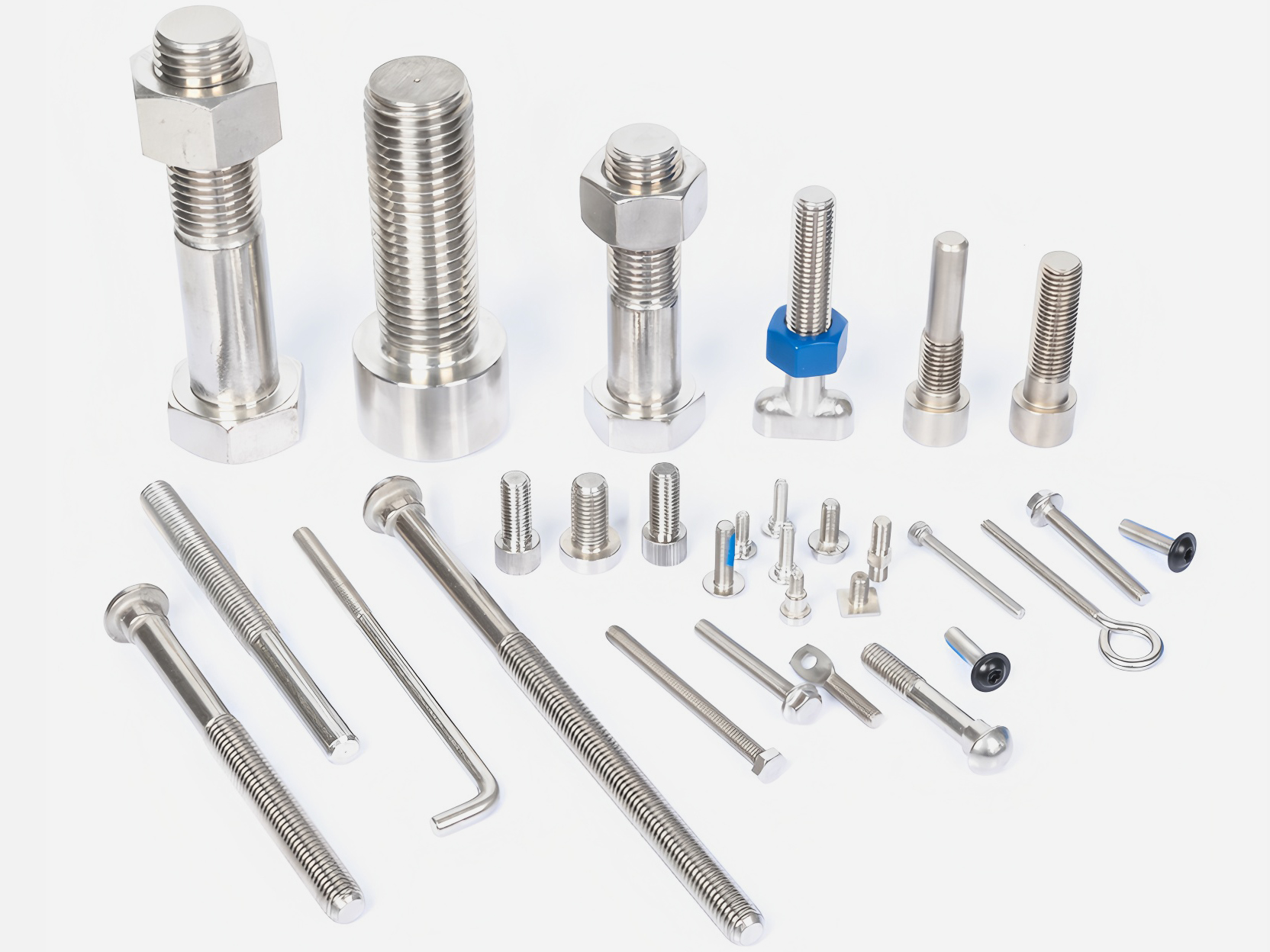
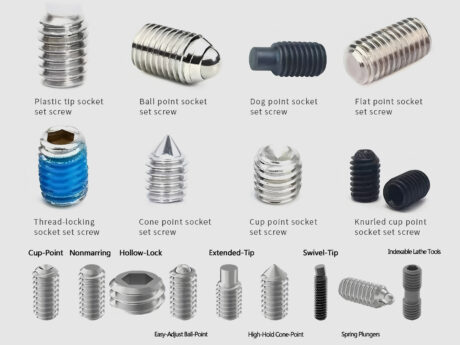
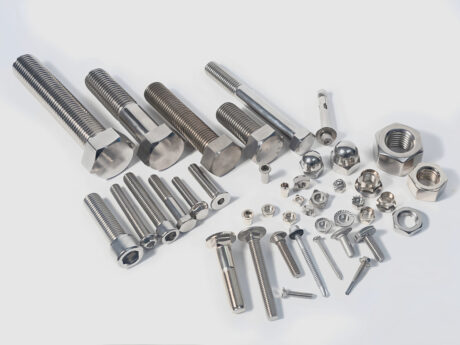
Nickel fasteners encompass a broad family of threaded mechanical fastening components — including bolts, screws, studs, nuts, and washers — manufactured from pure nickel and nickel‑based alloys. These fasteners are used in environments demanding high corrosion resistance, elevated temperature performance, chemical stability, and mechanical integrity (e.g., chemical processing, offshore, aerospace, power generation, petrochemical).
Materials may range from commercially pure nickel to high‑strength nickel alloys (Monel®, Inconel®, Hastelloy®, etc.), each selected based on service temperature, corrosion environment, and mechanical requirements.
2. Materials & Alloy Grades
Nickel fasteners are made from nickel base and nickel alloy families. Key alloy systems, common UNS designations and typical applications:
2.1 Pure Nickel (Wrought Commercial Nickel)
-
Alloy Types: Nickel 200 / Nickel 201
-
UNS: N02200 (Nickel 200), N02201 (Nickel 201)
-
Features: Excellent corrosion resistance in wet and reducing environments; good ductility.
-
Raw Material Standards: ASTM B160 (Nickel 200/201 rod, bar) and related B‑specs for forming.
2.2 Nickel‑Copper Alloys (Monel®)
-
Alloy Types: Monel 400, Monel K‑500
-
UNS: N04400 (Monel 400), N05500 (Monel K‑500)
-
Features: Outstanding resistance to sea water & reducing environments; K‑500 for improved strength.
2.3 Nickel‑Chromium Alloys
-
Alloy Types: Inconel 600, Inconel X‑750 (and others)
-
UNS: N06600 (Inconel 600), others per alloy
-
Features: High temperature oxidation & corrosion resistance.
2.4 Nickel‑Chromium‑Molybdenum / Nickel‑Molybdenum Alloys
-
Alloy Types: Inconel 625, Inconel 718, Hastelloy C‑276
-
UNS: N06625 (Inconel 625), N07718 (Inconel 718), N10276 (Hastelloy C‑276)
-
Features: Excellent corrosion resistance & high strength; 718 is precipitation hardenable.
2.5 Other Nickel Alloys
-
Incoloy (Nickel‑Iron‑Chromium): e.g., Incoloy 800/800H for high temp oxidation.
-
Many other UNS alloys are used depending on application.
(UNS = Unified Numbering System for Metals)
3. Governing Standards
3.1 Fastener Specification Standards
ASTM International Standards:
-
ASTM F468 – Standard Specification for Nonferrous Bolts, Hex Cap Screws, Socket Head Cap Screws, and Studs for General Use
• Governs commercial wrought nonferrous fasteners (including nickel alloy types) for general service, with specified mechanical properties, chemical limits, and manufacturing/inspection requirements. Applicable nominal diameters typically 0.250″ (1/4 in) to 1.500″ and corresponding socket head configurations. -
ASTM F467 – Specification for Nonferrous Nuts for General Use
• Companion to F468; applicable to nuts paired with nonferrous bolts/cap screws. -
ASTM F2281 – Standard Specification for Stainless Steel and Nickel Alloy Bolts, Hex Cap Screws, and Studs, for Heat Resistance and High Temperature Applications
• Covers chemical/mechanical requirements for high‑temperature stainless and nickel alloy fasteners intended for service up to ~1800 °F (982 °C). -
ASTM F468M – Metric version of F468 (for metric threads/sizes).
Material Source Specifications (raw bar/rod material):
-
ASTM B160 / B161: Nickel 200/201 rod, bar, profiles
-
ASTM B164: Monel 400
-
ASTM B166: Inconel 600
-
ASTM B446: Inconel 625
-
ASTM B637: Inconel 718
-
ASTM B574: Hastelloy C‑type alloys
(These material specs define chemistry & physical properties of starting material used to manufacture fasteners.)
3.2 Dimensional Standards
Fastener geometry and threads are governed by:
-
ASME B18.2.1 – Hex bolts & screws (inch series)
-
ASME B18.2.2 – Nuts, hex
-
ASME B18.3 – Socket head cap screws, shoulder screws
-
ASME B1.1 – Unified Inch Screw Threads (UN/UNF)
-
ISO 68‑1 / ISO 261 / ISO 965 – ISO Metric thread form, pitch and tolerances
(ASME/ISO provide thread geometry, tolerance, pitch, gauge definition.)
4. Specifications & Mechanical Requirements
4.1 Chemical & Mechanical Properties
Each alloy has specific chemical composition limits (Ni, Cr, Mo, Fe, Cu, etc.) and mechanical requirements. For example:
-
ASTM F468 lists allowable nickel alloy compositions and minimum mechanical performance characteristics (tensile strength, yield, elongation, hardness) for each alloy in the spec.
-
ASTM F2281 includes mechanical properties tailored for high‑temperature performance and corrosion.
4.2 Property Conditions & Grades
Nickel alloy fasteners may be furnished in different conditions (heat treated / annealed / solution treated / age hardened) depending on alloy:
| Alloy | Typical Condition | Strength Characteristic |
|---|---|---|
| Nickel 200 / 201 | Annealed | Moderate strength, excellent ductility |
| Monel 400 | As‑formed or stress‑relieved | Good strength & corrosion resistance |
| Monel K‑500 | Solution annealed & aged | Higher strength |
| Inconel 625 | Annealed | High strength with corrosion resistance |
| Inconel 718 | Solution treated & precipitation hardened | Very high strength |
| Hastelloy C‑276 | Annealed | Excellent corrosion resistance |
(Specific finishing conditions are defined by purchaser declaration and standard test requirements.)
5. Sizes & Dimensional Ranges
5.1 Fastener Types & Size Charts
Nickel fasteners are available as:
External Threaded Fasteners:
-
Bolts / Hex Cap Screws:
• Inch sizes: 1/4″ to 1‑1/2″ diameter typical (per ASTM F468)
• Metric sizes: M6 to M36 typical (per ASTM F468M) -
Socket Head Cap Screws / Button Head / Flat Countersunk: per ASME B18.3
-
Studs: Custom lengths; continuous or double‑ended
Internal Thread Fasteners:
-
Nuts: Corresponding to bolt size with standard hex dimensions (ASME B18.2.2 / ISO 4032)
Thread Pitches & Forms:
-
Inch: UNC (Unified Coarse), UNF (Unified Fine), UNEF as required
-
Metric: Coarse and fine pitches per ISO 261 & ISO 262
Washers: Per ASME B18.21.1 (flat & lock washers, inch series) or ISO 7090 (metric).
6. Marking & Traceability
Professional‑grade nickel fasteners include head markings or packaging tags indicating:
-
Alloy designation / UNS number
-
Manufacturer identification
-
Heat treatment / condition
-
Traceability to standards (ASTM F468 / F2281)
-
Lot and heat numbers
Quality documentation such as EN 10204 3.1 / 3.2 certificates is often supplied.
7. Corrosion & Environmental Performance
Nickel and its alloys provide:
-
High resistance to corrosion in chloride, acidic, and reducing environments
-
High temperature oxidation stability
-
Low magnetic permeability (for some alloys)
Service selection must consider:
-
Operating temperature
-
Chloride concentration
-
Stress corrosion cracking susceptibility
-
Galvanic compatibility
(Engineering selection should consult alloy chemistry and service environment specifics.)
8. Typical Applications
-
Chemical & petrochemical plants
-
Marine environments & offshore
-
Aerospace & gas turbines
-
Heat exchangers & boiler components
-
Pharmaceutical processing
-
Food processing equipment
9. Summary – Selection Guide
When specifying nickel fasteners, the essential items in a technical purchase specification include:
-
Fastener type: Bolt / Screw / Stud / Nut
-
Nominal size & length: e.g., M12 × 1.75 × 50
-
Thread form & pitch: UNC / UNF / Metric
-
Material & UNS alloy: e.g., N06625 (Inconel 625)
-
Standard compliance: ASTM F468 / F2281 / ASME B18
-
Condition / heat treatment: Annealed / Solution treated / Aged
-
Quantity & packaging requirements
-
Test certificates & quality documentation