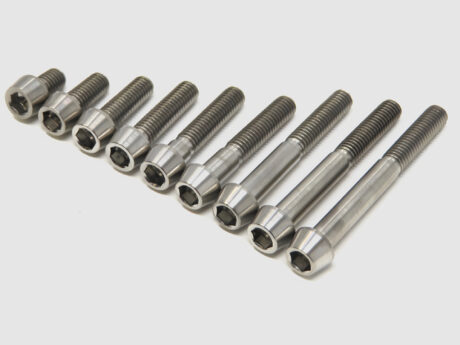
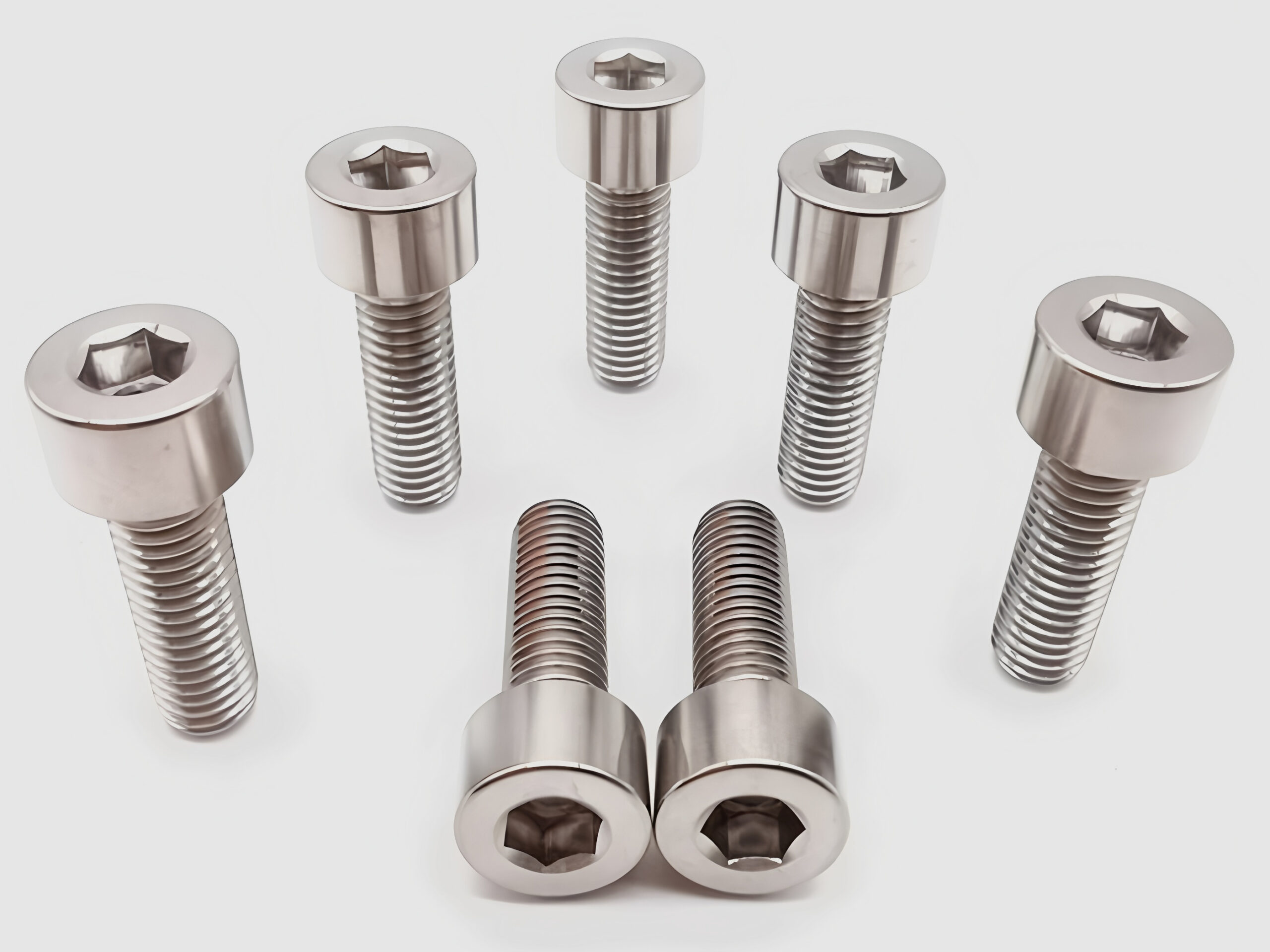
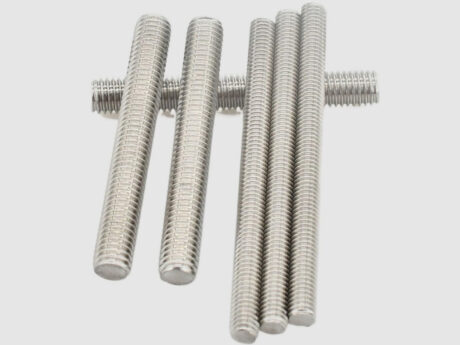
Titanium Socket Head Cap Screws (SHCS), commonly referred to as titanium internal hex bolts, are precision fasteners characterized by a cylindrical head with an internal hexagonal socket (Allen drive). This design allows for high torque application, a compact and low-profile installation, and a clean finish, making them ideal for applications where space is limited and reliability is critical. They are renowned for their exceptional strength-to-weight ratio, excellent corrosion resistance, and good biocompatibility .
2. Material Grades and Properties
Titanium bolts are available in commercially pure (CP) grades and titanium alloys, each offering a unique balance of strength, corrosion resistance, and formability. The key grades are detailed below .
|
Grade / Common Designation
|
Primary Composition
|
Key Characteristics & Typical Applications
|
|---|---|---|
|
Grade 1
|
Commercially Pure Titanium (CP)
|
Excellent ductility and formability. Highest corrosion resistance among CP titanium. Used in chemical processing equipment and marine hardware where maximum corrosion resistance is required .
|
|
Grade 2
|
Commercially Pure Titanium (CP)
|
The most common and versatile CP grade. Offers an optimal balance of strength, ductility, and corrosion resistance. Widely used in general industrial, architectural, and marine applications .
|
|
Grade 5 (Ti-6Al-4V)
|
Ti-6Al-4V Alloy
|
The industry-standard high-strength alloy. Offers the highest strength-to-weight ratio, about twice as strong as Grade 2. Ideal for high-stress applications in aerospace, automotive, and medical implants .
|
|
Grade 7
|
Ti-0.2Pd Alloy
|
Enhanced corrosion resistance, particularly in reducing acid environments due to the addition of Palladium (Pd). Suitable for chemical processing and pharmaceutical equipment .
|
|
Grade 9 (Ti-3Al-2.5V)
|
Ti-3Al-2.5V Alloy
|
Strength superior to CP titanium with excellent cold formability and superior fatigue resistance. Often used in hydraulic tubing, aircraft components, and bicycle frames .
|
|
Grade 12
|
Ti-0.3Mo-0.8Ni Alloy
|
Superior corrosion resistance to Grade 2 and 7 in crevice conditions and at elevated temperatures. Used in heat exchangers, chemical vessels, and desalination plants .
|
|
Grade 23 (Ti-6Al-4V ELI)
|
Ti-6Al-4V ELI Alloy
|
Extra Low Interstitial (ELI) version of Grade 5. Offers enhanced fracture toughness, ductility, and biocompatibility. Primarily used in medical implants (orthopedic, dental) and critical aerospace applications .
|
3. Standards, Specifications, and Dimensions
Titanium SHCS are manufactured to conform to international standards that define their dimensions, tolerances, and mechanical properties .
-
Common Standards:
-
DIN 912 / ISO 4762: The most prevalent standards for metric Socket Head Cap Screws.
-
ANSI/ASME B18.3.1M: The standard for imperial (inch-series) Socket Head Cap Screws in North America.
-
-
Size Range:
-
Diameter: Commonly available from M1.6 up to M36 or larger for custom orders .
-
Length: Typical lengths range from 6 mm to 300 mm, depending on the diameter .
-
Example of Dimension Table for DIN 912 (Metric) :
|
Nominal Diameter (d)
|
Head Diameter (dk) max.
|
Head Height (k) max.
|
Socket Size (s)
|
|---|---|---|---|
|
M4
|
7.0 mm
|
4.0 mm
|
3 mm
|
|
M6
|
10.0 mm
|
6.0 mm
|
5 mm
|
|
M8
|
13.0 mm
|
8.0 mm
|
6 mm
|
|
M10
|
16.0 mm
|
10.0 mm
|
8 mm
|
|
M12
|
18.0 mm
|
12.0 mm
|
10 mm
|
4. Mechanical and Physical Properties
The following table compares key properties of major grades (representative values; exact figures depend on heat treatment and manufacturing process) .
|
Property
|
Grade 2 (CP)
|
Grade 5 (Ti-6Al-4V)
|
Grade 23 (Ti-6Al-4V ELI)
|
|---|---|---|---|
|
Tensile Strength (min)
|
345 MPa
|
895 – 1100 MPa
|
828 MPa
|
|
Yield Strength (min)
|
275 MPa
|
828 – 950 MPa
|
759 MPa
|
|
Elongation (min %)
|
20%
|
10%
|
10%
|
|
Density
|
4.5 g/cm³
|
4.51 g/cm³
|
4.51 g/cm³
|
|
Notable Feature
|
Excellent corrosion resistance
|
Highest strength-to-weight ratio
|
Enhanced toughness & biocompatibility
|
General Physical Properties:
-
Lightweight: Density is about 60% that of steel .
-
Corrosion Resistance: Excellent resistance to seawater, chlorides, and a wide range of chemicals, far surpassing stainless steels in many environments .
-
Non-Magnetic: Inherently non-magnetic, making them suitable for MRI equipment and sensitive electronics .
-
Biocompatibility: Grades 1, 2, 5, and particularly 23 are biocompatible and widely used in medical implants .
5. Surface Treatment Options
-
Polishing/Mechanical Finish: A smooth, bright surface that improves aesthetics and slightly reduces friction .
-
Anodizing: An electrochemical process that increases the thickness of the natural oxide layer, enhancing corrosion and wear resistance. It allows for color customization (e.g., blue, purple, gold, green) for part identification or aesthetics .
-
Passivation: A chemical process that removes free iron and other surface contaminants, promoting the formation of a stable, passive oxide layer for maximum corrosion resistance .
6. Application Industries
-
Aerospace: Aircraft structures, engines, and landing gear (primarily Grade 5, Grade 9) due to high strength-to-weight ratio .
-
Medical: Surgical instruments, orthopedic implants, and dental devices (primarily Grade 5, Grade 23) due to biocompatibility and strength .
-
Marine & Offshore: Boat fittings, subsea equipment, and desalination plants (primarily Grade 2, Grade 7, Grade 12) due to exceptional seawater corrosion resistance .
-
Chemical Processing: Reactors, heat exchangers, and piping systems (primarily Grade 2, Grade 7, Grade 12) for handling corrosive acids and chlorides .
-
High-Performance Automotive & Racing: Engine components and chassis fasteners (primarily Grade 5) for weight reduction and strength