


Titanium Surface Coloring Treatments
Common titanium surface coloring processes include the following:
-
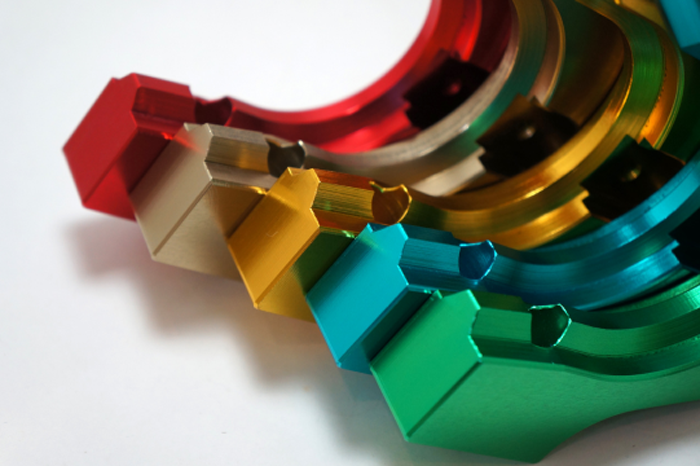
Anodizing (Electrochemical Coloring)
An electrochemical process that forms an oxide layer on the titanium surface. Different colors are achieved by precisely controlling the voltage and oxide thickness. Commonly used for decorative, aerospace, and medical applications. -
Thermal Oxidation (Heat Coloring)
Titanium is heated in air or a controlled atmosphere to form oxide layers of varying thickness, producing different colors. This method is relatively simple but offers limited color consistency and control. -
PVD Coating (Physical Vapor Deposition)
A thin ceramic coating (such as TiN, TiCN, or TiAlN) is deposited onto the titanium surface, resulting in colors like gold, black, bronze, or blue, while also improving wear and corrosion resistance. -
CVD Coating (Chemical Vapor Deposition)
Similar to PVD, but performed at higher temperatures, producing durable and uniform colored coatings for high-performance industrial applications. -
Laser Coloring / Laser Surface Treatment
Laser energy is used to modify the surface oxide structure, generating controlled color effects with high precision. Suitable for markings, patterns, and high-end decorative parts. -
Chemical Coloring / Chemical Oxidation
Chemical solutions are used to react with the titanium surface and form oxide layers that create color changes. Color range and durability depend on process control. -
Plasma Electrolytic Oxidation (PEO / Micro-Arc Oxidation)
An advanced anodizing process that produces thicker, ceramic-like oxide layers with enhanced color stability, wear resistance, and corrosion resistance. -
Electroplating (with Intermediate Layers)
Although titanium cannot be directly electroplated easily, surface activation allows plating of metals (such as nickel or gold), providing both color and functional properties.